Showing posts with label autumn. Show all posts

Thursday, November 22, 2012

Fall's Last Hurrah

Most of these pictures were taken a few weeks ago.

Sadly, with the rough year we have had, the colorful fall foliage was bright but brief. 


Jordan River in the middle of Indiana University is still running low.


Colorful trees across the parking lot at the Indiana Memorial Union.


Sugar maple on the west side of town.  
I am sorry that I missed the peak of this tree's magnificence.*

*Do as I say and not as I do: Don't take pics as you are driving!
Leave that for the professionals.


A late season bouquet.


And snow!

Ack, snow!
Make it go away!


Tuesday, October 23, 2012

Leonard's Springs in the Fall - After the Drought

One fine fall day a few weeks ago I ventured back to Leonard Spring's Nature Preserve to see how it had fared after this year's "exceptional drought." 

At one point this summer we were determined as being under the worst level of drought possible.  We are finally getting rain and the U. S. Drought Monitor Map now shows that we are now only "abnormally dry."

However, only time will tell how much damage was done to the trees and other important vegetation.


 Blue asters in bloom.
Asters are native flowers.

 One of the caverns in the nature preserve.


 The lower cave.


 Happily, the graffiti has been removed.
Now I am happy again.
Stupid gangs.


 The drought has really depleted the springs' water reserves.


 At first I was wondering where the falls were, but then I realized that I was standing where the falls usually ran.


 They are still very pretty.


 I love this shot.


 This is the underside of a massive uprooted tree.


On the way back to the car, I saw this fallen, decaying log that was giving life to new plants.

And I suppose that is the true lesson here.
Life is a perpetual cycle of birth, death and rebirth.

Less than ideal weather conditions may occur, but nature and life go on.

Monday, October 8, 2012

The October Garden

Little is flowering in my garden after this hot and very dry summer.
We are still trying to recover from the drought, and though we are finally receiving some much needed rain, we are still considered to be in drought conditions.

As such, many flowers that usually would still be blooming this time of year have long since set seed and are shutting down for the year.

The surprise for me this year has been my roses.
They have loved this drought.  I have not watered any of them, and even my English roses, which normally only bloom reliably once a year, are now blooming for the fourth time.
Whodathunk?


The Victoria Blue Salvia wintered over from last year.
I love this flower.  The blue is so vibrant and the flower lasts long into the cool autumn months.


My miniature rose, Rainbow's End, is in its fourth bloom.
This is a lovely rose.
The flowers start out yellow, then progress to orange, red, and then pink before fading.  
It has no fragrance, but it is a must-have rose for the garden and is good for a small spot.


Rainbow's End bloom beginning to turn from orange to red.


Dogwood with berries.


The birds will soon pick the berries off the trees.


Burning bush or winged euonymus.


English Perfume, an English rose.
As the name implies, a heavily scented rose.


My all time favorite English rose, which is named after a great gardener, Gertude Jekyll.

This is one of the most highly-scented roses you will ever find in the garden.


My hydrangea has many mauve blooms on it.
I suspect that is a result of recent cold nights.


Milkweed bugs congregating on the butterfly bushes.


Unusual colors for a fall bouquet.
I had to search the garden to find yellow for the arrangement.


Hydrangeas for another fall arrangement.


And it was finally time to bring my houseplants back inside for the year.
After the watering ban was lifted a few weeks ago, I happily chucked the plants back outside, only to have to bring them back inside this past weekend.

In late March I took this bay tree out to the back deck.  Please note the height.


On Friday I had to bring it back inside.
It was very happy outside this summer.
The plants at the bottom are petunias.


Please note the red line in the picture.
That shows just how much the tree has grown this season.
I'm seeing a pruning come next spring.


Wednesday, November 23, 2011

A Fungus Among Us
(or a Funky Fungus)

While walking around my garden today,
I spotted this unusual specimen growing
in the mulch under a tree.

It has been cool and wet lately,
so it is perfect weather for mushrooms
and fungus.


I'm really not sure what this is.

Our new neighbor's four year old son
said it looks like a milk bottle.


Oddly, it has a hole in the center.


It is 5" long and the stem is 1" wide.


I spent over half an hour searching on the the Internet
and still could not find out what kind of mushroom or
fungus this is.

Any ideas?

Friday, October 28, 2011

An Autumn Dinner:
Homemade Applesauce and
Apple-Glazed Pork Loin

I recently found a lovely pork loin on sale 
at my local grocery store (sorry, Sandra Lee speak:
what, would I travel to someone else's local grocery
store to buy food?)
That got my mind grinding and sparking
on an Autumn menu.
Pork and apples.
The food of the Gods.
I can taste it already.


The first task was homemade applesauce.

I used Honeycrisp apples.
These apples are my favorite apples.
They are sweet and they keep almost forever.*
I have been able to keep these beauties in the
crisper of my fridge for over a year, with little
discernible loss in quality,
other than a slight bruising of the flesh.
They still taste good and are good for cooking.

*Forever may be subjective and 
cannot be qualified in legal terms.

Sarah's Applesauce Recipe

4 apples, peeled, cored and chopped
3/4 cup water
1/4 cup white sugar

1/2 teaspoon ground cinnamon


Combine all ingredients in a saucepan and
cook over medium heat for 15 to 20 minutes,
or until apples are soft.
Allow to cool and mash apples with a fork or
potato masher.


This is my new favorite applesauce recipe.
Thanks, Sarah.
(Folks, this may be a first:
I actually followed the recipe!
And you didn't think it could be done.)


Next up was an Apple-Glazed Pork Loin.

Of course, I couldn't stick with the recipe here, 
starting with the brine.

Here is my riff on the recipe:
Brine:
4 cups water
1/4 cup kosher salt
1/2 cup light brown sugar
1 bay leaf
1/4 cup cider vinegar*

*Whoever heard of a brine without an acid?

Pork Loin:
1 boneless pork loin
 Freshly ground pepper, to taste
1/4 cup fresh sage, chopped
2 tablespoons extra virgin olive oil

Glaze:
2 tablespoons whiskey
2 tablespoons apple jelly
2 tablespoons F.R.O.G. preserves.**

**Fig, Raspberry, Orange, Ginger preserves

Nuke the brine in microwave-safe container
on high for five minutes.
Take out and stir, stir, stir, 
until the salt and sugar are completely dissolved.

Add ice cubes and cold water 
to the hot brine to bring the brine to room temp
and to double the volume.

Then and only then can you safely add the pork to the brine.
Submerge the pork in the brine completely for at least four hours.
Since we have added acid to the mix, we have cut down
the brining time significantly.
Place in the fridge.

One to One-and-a half hours before
it is time to start cooking the pork,
take the pork loin out of the brine
and leave out at room temp.

Season the pork with the ground black pepper and sprinkle with
the minced sage.

Heat grill and place pork loin on preheated grill.

Cook until the internal temperature reaches 140 degrees
and not one degree more.***

Do not make me hunt you down!

Trust me on this!

Baste with the glaze at the last minute,
lest the pork burn excessively.

Remove from heat,
cover and let rest for five to ten minutes
before carving.
***Despite what your lovely grandmother may have told you, 
pork does not need to become hard and tough
like shoe leather to become edible.
With today's food safety practices
pork is perfectly safe 
cooked at 140 degrees,
before carry over heat adds an additional 5 to 10 degrees.
And the reason we all worry about undercooking pork?
That nasty little tape worm,
or teniasis****, used to thrive in pigs,
thanks to the fact that pigs were historically fed
scraps and garbage.
Now their diets are vastly improved
and science has shown that
heating the meat to 138 degrees
will kill the eggs of this nasty parasite
if it manages to manifest in the modern
porcine population.

Recently the FDA has relaxed
its rigorous standards
and has suggested that
pork can be cooked to 145 degrees.
I still maintain that this is overkill,
as the final resultant temperature would be 155.

Pork should be just slightly pink in the middle
and oh, so tender.
Try this and you will be a convert.
Just don't forget the meat thermometer.

****Oddly enough,
it is rumored that around the turn of the 20th century,
there were tapeworm diets available
for those wishing to lose weight.
Whether or not that is actually true
has not been determined,
but it would have to have been a desperate person
to have even contemplate such a thing.
EWWW!


Saturday, October 22, 2011

Autumn at McCormick's Creek

This is a trip that has been on my agenda
for a couple of years now.
I had to postpone it last year due to the drought.
No sense in going to see a waterfall
if it was dry.

As the weather was dry this summer
as well, I had to bide my time.
Then it rained and rained earlier this week
and I knew the time was right to visit
McCormick's Creek.

I had hoped that the Foodie Daughter 
would be coming along with me,
but she had to work.
Oh well, I'll just have to go it alone then.

Remember;
do as I say and not as I do.
Don't take pictures as you drive.


Fall foliage on the drive to McCormick's Creek.


These are the remains of several quarries that opened 
in the 1890s.  


Stone from these quarries was used to build 
the Immigration Center at Ellis Island.


A line of American Sycamore trees.


McCormick's Creek was Indiana's first state park
and was established in 1916.


Looks like it is busy today.


I have my annual park pass ready.


The sign says that the caves and sinkholes are closed
in order to help protect the park's bats
from White-nosed syndrome, 
a fungus that is killing bats in large numbers.


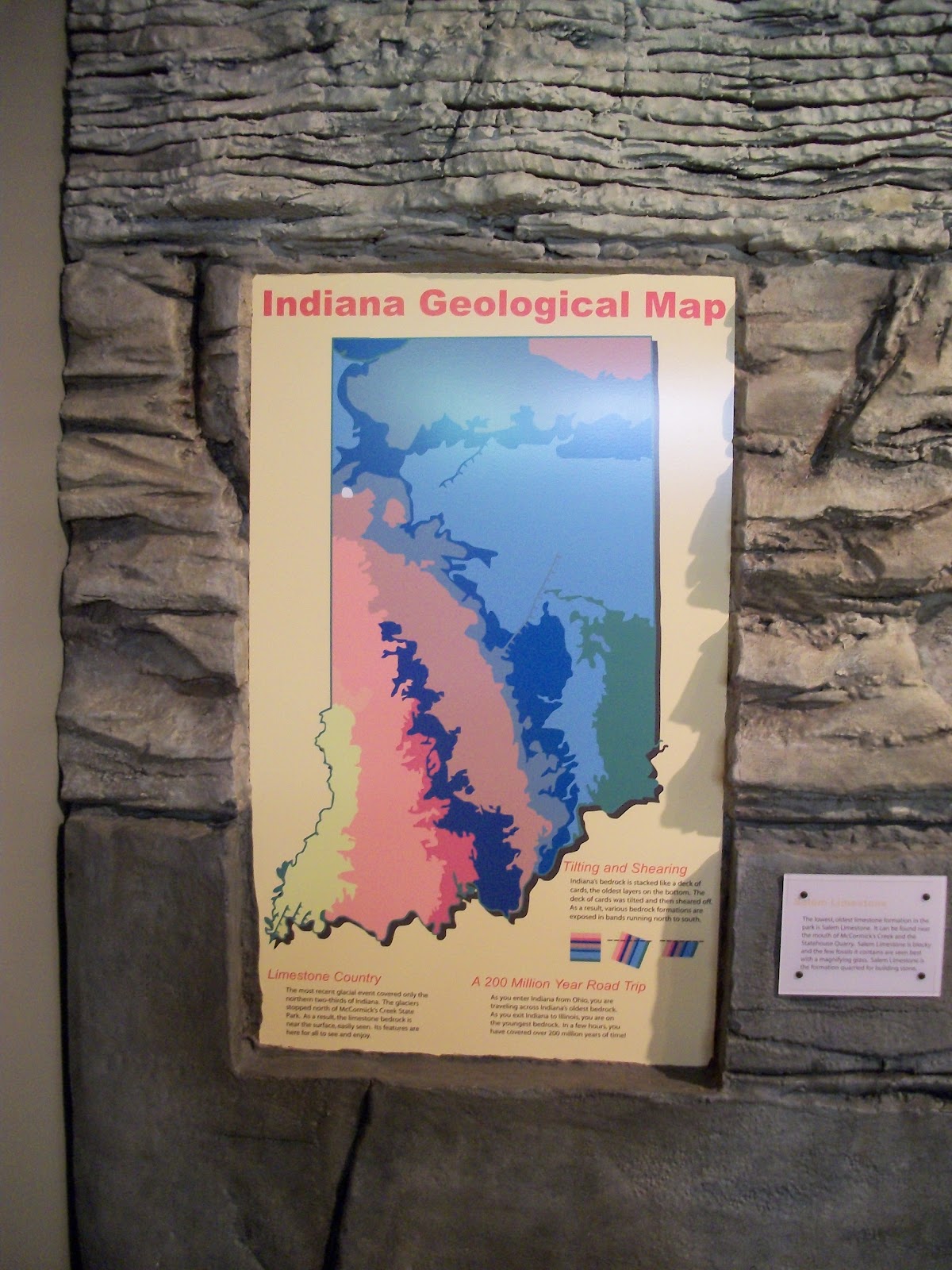
I stopped in at the nature center first.


Geodes.
We have those.
I can't dig in my garden without finding a geode.


Karsts are common in limestone country.

A karst is essentially an underground cavern, 
to put it simply.


I was here for the falls,
so I headed over to the canyon 
and began the journey down.


The falls from the overlook.


Looking across the canyon.


At this point I could have played it safe and stayed 
on the concrete pad,
or I could have made the treacherous journey
across the creek so that I could get better pictures.
Three guesses as to what I chose to do
and the first two don't count.


Colorful fungus on a fallen log.


Be a good steward and make sure that the
only things you take with you are memories and photos.


Looking up.


Looking downstream.


Fossils in a rock.


If you look very carefully, 
you will see that someone at sometime
scratched the skeleton of a fish on this rock.


More fossils.


After half an hour
I finally made it around to the other side of the creek.
Arrow-leaved aster.


Interesting pattern pressed into the surface of the rock.


Back where all those people are is where I started out.


The falls, up close and personal.

The falls are only about 12 feet tall, but they are lovely.


Now I just have to make my way back.

But for now I am taking a break.
Right here on a big rock in the middle of the creek.


This big rock.
After almost falling into the creek
I think I deserve a rest.


Whew, I finally made it back up to the top.
It was a lot easier going down than
coming back up.

I did have to take my asthma inhaler after
that major workout.

In all I spent almost an hour climbing up and over and around
rocks and boulders and ducking under fallen trees.

I found a shady place to park and ate 
the small sandwich that I had packed and brought with me
while I caught my breath.
Canyon Inn.
This inn was built on the site where a sanitarium was 
originally built in the late 1800s by a doctor 
who felt that this area was the perfect place for 
"the wealthy and weary to get away 
from it all and recuperate."

I can agree with that,
as I feel refreshed and rejuvinated.