Autumn at McCormick's Creek
This is a trip that has been on my agenda
for a couple of years now.
I had to postpone it last year due to the drought.
No sense in going to see a waterfall
if it was dry.
As the weather was dry this summer
as well, I had to bide my time.
Then it rained and rained earlier this week
and I knew the time was right to visit
McCormick's Creek.
I had hoped that the Foodie Daughter
would be coming along with me,
but she had to work.
Oh well, I'll just have to go it alone then.
Remember;
do as I say and not as I do.
Don't take pictures as you drive.

Fall foliage on the drive to McCormick's Creek.


These are the remains of several quarries that opened
in the 1890s.

Stone from these quarries was used to build
the Immigration Center at Ellis Island.

A line of American Sycamore trees.


The entrance to McCormick's Creek State Park.
McCormick's Creek was Indiana's first state park
and was established in 1916.

Looks like it is busy today.

I have my annual park pass ready.

The sign says that the caves and sinkholes are closed
in order to help protect the park's bats
from White-nosed syndrome,
a fungus that is killing bats in large numbers.


I stopped in at the nature center first.

Geodes.
We have those.
I can't dig in my garden without finding a geode.


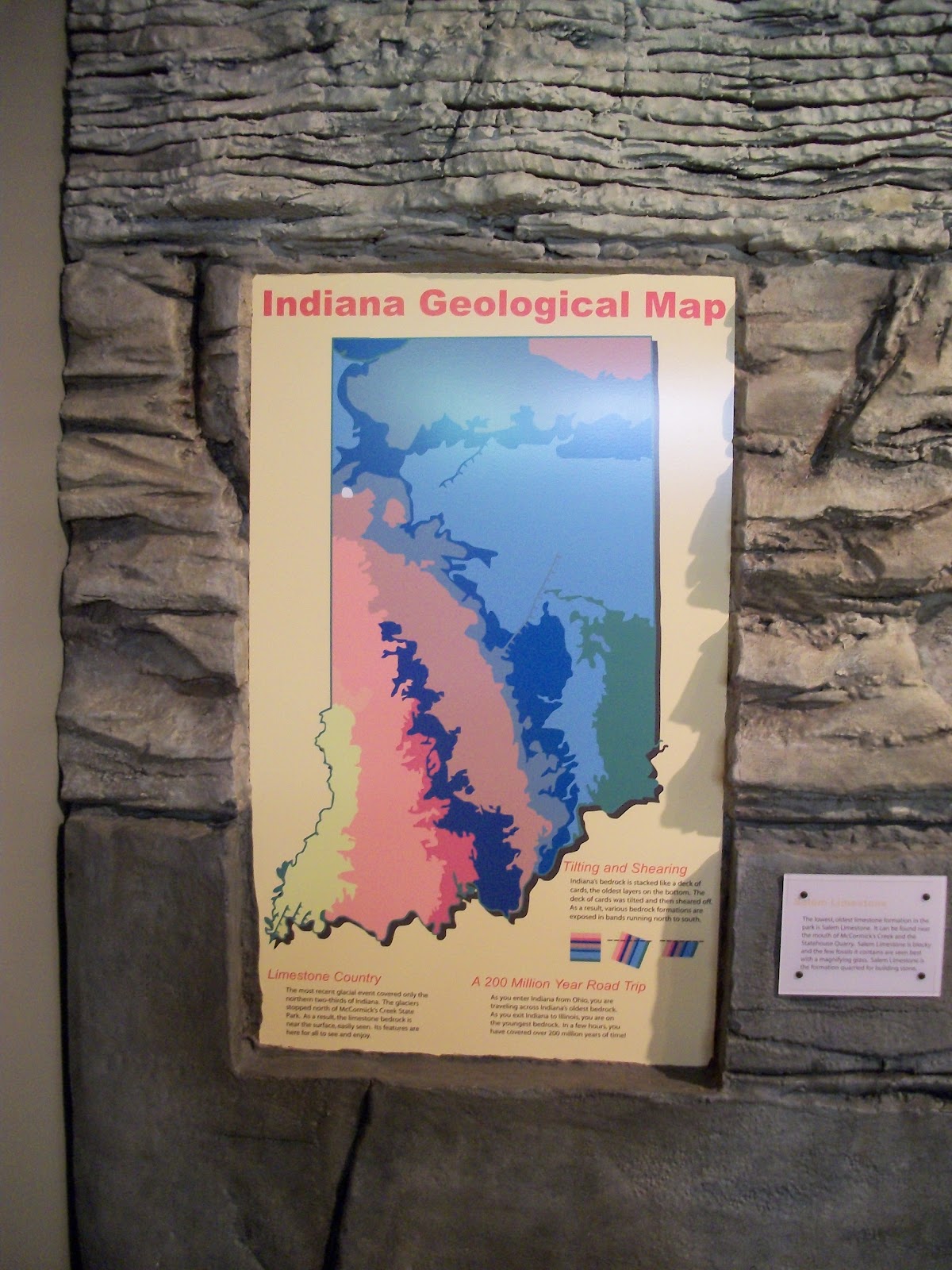
Karsts are common in limestone country.
A karst is essentially an underground cavern,
to put it simply.


I was here for the falls,
so I headed over to the canyon
and began the journey down.

The falls from the overlook.

Looking across the canyon.


At this point I could have played it safe and stayed
on the concrete pad,
or I could have made the treacherous journey
across the creek so that I could get better pictures.
Three guesses as to what I chose to do
and the first two don't count.

Colorful fungus on a fallen log.


Be a good steward and make sure that the
only things you take with you are memories and photos.

Looking up.


Looking downstream.

Fossils in a rock.

If you look very carefully,
you will see that someone at sometime
scratched the skeleton of a fish on this rock.

More fossils.

After half an hour
I finally made it around to the other side of the creek.

Arrow-leaved aster.

Interesting pattern pressed into the surface of the rock.

Back where all those people are is where I started out.

The falls, up close and personal.
The falls are only about 12 feet tall, but they are lovely.

Now I just have to make my way back.
But for now I am taking a break.
Right here on a big rock in the middle of the creek.

This big rock.
After almost falling into the creek
I think I deserve a rest.

Whew, I finally made it back up to the top.
It was a lot easier going down than
coming back up.
I did have to take my asthma inhaler after
that major workout.
In all I spent almost an hour climbing up and over and around
rocks and boulders and ducking under fallen trees.
I found a shady place to park and ate
the small sandwich that I had packed and brought with me
while I caught my breath.

Canyon Inn.
This inn was built on the site where a sanitarium was
originally built in the late 1800s by a doctor
who felt that this area was the perfect place for
"the wealthy and weary to get away
from it all and recuperate."
I can agree with that,
as I feel refreshed and rejuvinated.