Showing posts sorted by relevance for query black orchid. Sort by date Show all posts

Sunday, August 17, 2008

Folia and Flora

As a gardener, it is always a joy harvesting homegrown produce. And today I proudly present to you the first bell pepper of the season. Drum roll please...


Well okay, it is a bit wonky-shaped.


All right, and it's a bit small.


Hee hee, it looks funky no matter how you look at it. But I grew it myself, so I'm proud of it. So there!


And how is this for an odd orchid? According to the tag (as I do not believe that this particular orchid has ever bloomed for me before) it is an Epidendrum cochleatum X self orchid. A quick Google search shows that the new name for this orchid is Encyclia cochleatum. This orchid is the national flower of Belize and is called the Black Orchid as well as the Octopus Orchid.

What I can tell you is that this is a difficult orchid to photograph as the flower proper is about the size of a dime. Gotta love those orchids.

Sunday, April 6, 2008

Orchids - A Practical Lesson

A few weeks ago, I was asked a question about orchids and whether dying blooms also signalled the demise of the plant. Indeed, some orchids bloom for such long periods of time that it may seem that the flowers are a permanent fixture (for instance, this particular orchid had been blooming for over six months). So, now that I too am faced with the loss of these blooms on this orchid, I thought I would offer you the chance to actually see how to convince the orchid to quickly re-bloom. Please note that this method only works with Phalaeonopsis Orchids.


Here are the blooms of this particular Phal (or Moth) orchid. This picture was taken in October of last year. Since the orchid name was not provided, I have dubbed it 'Blushing Ladies'. I think that is appropriate.


And this is that same orchid in a picture taken this morning. Notice the stake and clips that secure the stalk.


The long oval leaves identifies this as being a Phal.


Well, look at this. Apparently the plant couldn't wait and began growing a new shoot off the old flowering stalk. The obvious choice here is to cut the stem at an angle just above the new growth. Had this not been present, I would have found a node (joint) that seemed alive and would have cut just before that.


And now we wait for the new stalk to grow and begin blooming.

Phals do not like to be wet all the time and benefit from allowing the soil to dry out between waterings. And if you see whitish-green roots above the soil, don't panic. Those are the aerial roots that allow the orchid to gain moisture from the air. As with many orchids, Phals are epiphytes (that is, they grow on other plants but do not damage the host plant), and these roots are vital to the health of the plant.

In addition, orchids seem to enjoy being pot-bound. A good orchid potting mix (bark and regular potting mix) is also essential. If you purchase an orchid that is potted with moss, please do yourself and your orchid a favor and re-pot it as soon as possible. I have found that the moss is either soaking wet or bone dry, neither of which is good for the plant.

Orchids grow naturally in dense canopies of trees and do not want nor need direct sunlight. While they enjoy bright light, the sun should never directly reach the plant or the leaves will be damaged and black spots will result. As most of my available window space is south facing, I keep my blinds down to filter the sunlight.

I do hope that you give these beautiful, low-care plants a chance.


Saturday, October 25, 2008

Autumn Interlude


One of the perks of being the Thrice Potent Master's wife is that I get to attend all sorts of events at the Scottish Rite in Indianapolis. Last evening we attended a play entitled "Love, Sex and the IRS". This was a very enjoyable comedy and the cast was quite engaging. I found out afterwards that I actually knew a few of the cast members. All in all, this was an enjoyable evening and my husband and I had a very nice time.


At the end of the evening we found out that our daughter's old high school football team had won their sectional game and so they get to play for at least one more week. Oh goody; another week of having Gatorade(tm) in my refrigerator before the game. I love that my daughter loves being manager of her old high school's team, but I do lament the loss of my refrigerator space.


The Indianapolis Scottish Rite Cathedral recently replaced the old spot lights highlighting the bell tower with new, energy efficient LED lights with color filters. Every few seconds the color of the bell tower changed colors. I watched as the colors ranged from yellow to orange to red to green to blue to purple. Awesome.


Scene break: the next morning:


I am once again attempting to get a good picture of my black orchid. My cat Midnight feels the need to investigate the situation.


I feel the need to remind you that this is a very difficult flower to photograph. But then again, I do love a challenge. Maybe some day I will actually get it right.


And this is my 'Blushing Ladies' moth orchid (phalaeonopsis). One of the interesting things about this orchid family is that the blooms are so long-lived that once they do begin to fade and drop, people wrongly think that they have somehow killed these hardy orchids. The truth is that orchids are very tolerant of their environment and can even accept our sometimes less than prompt attentions.


Tonight I will leave with the thought that each day is ours and ours alone. Enjoy and leave a positive mark on each place you have visited.

Thursday, January 29, 2009

The Snow Plow Cometh

Snow plow scene: take 2. This morning the intrepid snow plow driver once again attempted to clear our street and cul de sac. This might be a tad easier in the daytime.


It's still a bit difficult to maneuver the snow around the curve.


At least he didn't get stuck this time.


And see that? Just in time for my husband to leave for work.
It only took the snow plow half an hour to completely clear this short section of road.
All right, enough about that silly snow.


Do you remember seeing this picture of my terrestrial orchid a few weeks ago?


The little beauty is now fully blooming. This is Ludisia Discolor, which is also called the Black Jewel Orchid. This terrestrial orchid is native to Malaysia, Indonesia and Burma. However, this particular plant seems to be quite happy living in my breakfast room.


That is one of the nice things about orchids; they like to bloom during the gloomy winter days.

Saturday, September 18, 2010

Longwood Gardens


and QVC Studios


On Monday morning, August 30,


we traveled from the hotel to Longwood Gardens.


Longwood Gardens is the legacy of Pierre S. du Pont,


who is best known as


one of the leaders who helped bring the DuPont corporation


into the 20th Century as well as helping


to direct the development of General Motors.


For these reasons, Pierre S. du Pont is often


thought of as


"the father of the modern corporation."*


*Source: The Heritage of Longwood Gardens


Pierre S. du Pont and his Legacy,


http://www.longwoodgardens.org/


Now, Longwood Gardens has long


been on my Bucket List.


I was very happy to be able to


cross this item off the list.


We arrived at 9 am.


Happily, after our tour coordinator

paid for our tickets,

we were set free to explore the gardens at our leisure.

The only caveat was that we had just three hours

and that we had to also eat lunch in that time.


Longwood is a large place and I knew

that I simply could not see it all in less than three hours.


Thus, I had to choose the most important

areas and focus on those areas.


I can only hope that I can someday get back here.

This time I decided that I would focus on the original garden

that Mr. du Pont set out - the Flower Garden Walk

and the Conservatory.


After that I would see if I had time left to see more

of the gardens.


Lovely vistas abound.


Small gardens delight at every turn.


As I strolled down the garden walk,

I noted that the colors of the flowers melted

from purples to pinks to reds to yellows and finally to whites.


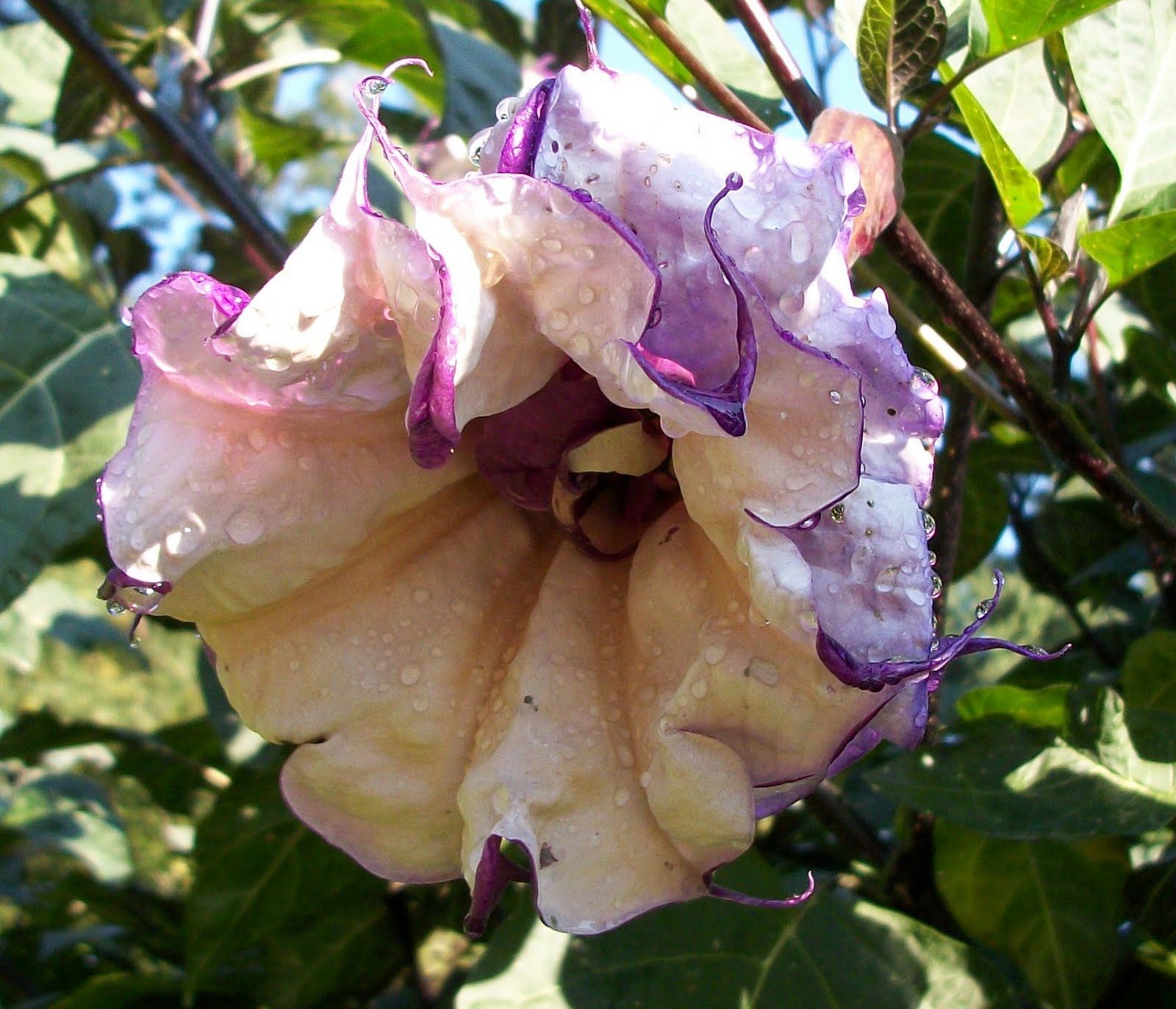
This lovely bloom is perhaps my favorite of the day.


It is an Angel's Trumpet

(Datura); it is in the nightshade family.

Please be warned that this plant is considered

dangerous as when ingested it acts as a narcotic.


Looking down the Flower Garden Walk.


Black Swallowtail butterfly.


Hidden garden at the end of the Flower Garden Walk.


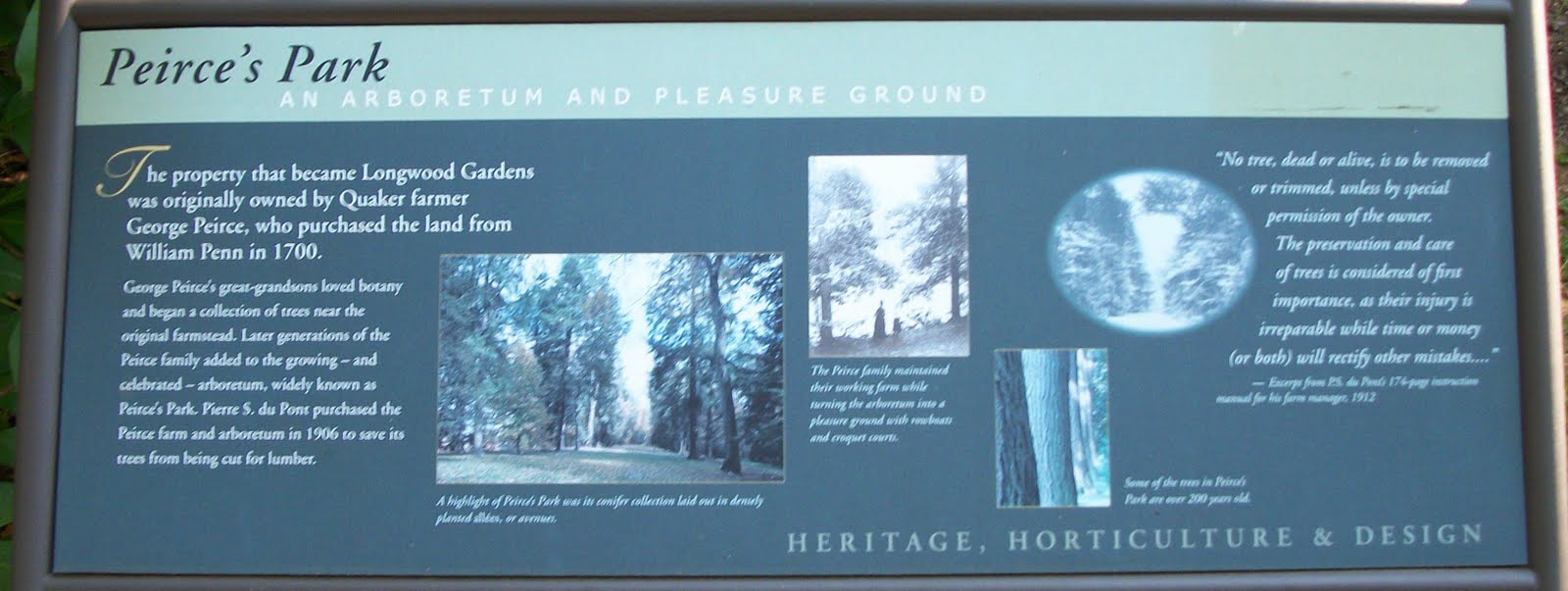
Sadly, I didn't have the time to visit Peirce's Woods.


The Peirce Family were the original

owners of the property.


Carnivorous potted plants.


Looking up the Flower Garden Walk.


Another missed opportunity this day.


The unassuming house.


On this day I had to forgo a tour of the house.


Mr. du Pont later added a conservatory and

second wing to the house.


And now for the piece do resistance -


I planned to spend most of my time here.


At about 4 and 1/2 acres,

Longwood's Conservatory is one of the largest

conservatories in the world.


The Main Fountain Garden

sits just to the south of the Conservatory.


There is a lot to see.


We'd better get going.


The Orangery.


Mr. du Pont hoped to grow oranges here,

but that didn't work out too well.


The Exhibition Hall.

An employee told me that there are two bougainvillea

vines in this area that were planted in 1921.


They now cover much of the room and are spectacular

when in bloom.


The East Conservatory.


Tell me you can't see yourself

sitting beside this pool and relaxing.


Interestingly, Mr. du Pont

never envisioned keeping this beauty

to himself.


Almost from the start,

he began to make plans to ensure

that these gardens would endure.


In 1914 Mr. du Pont formed

Longwood, Inc.


In 1937 he created Longwood Foundation

so that the gardens would be funded

even after his death.


The ballroom.


The organ.


Exhibition Hall.


The Exhibition Hall can be flooded

with a couple of inches of water

or it can be drained and used as a banquet space or

dance hall.


I walked out to the Waterlily Display area

and saw this vehicle filled with

ornamental pepper plants.


What a colorful display.


Not an inch of space was left to go to waste.


The Waterlily Display area

is open May through October.


Waterlilies and other aquatic plants grace

several ponds.


A varigated waterlily.


Ah, so that's were the ornamental pepper plants are going.


A newer area in the conservatory is the

Indoor Children's Garden.

The garden is child-size, although

adults can certainly wander in this garden.


Some children at play.


Bamboo in the East Conservatory.


The Accacia Passage.


The Orchid House.


The Banana House is just beyond

the Orchid House.


And now for the orchids.


The Mediterranean Garden


The Palm House


The Bonsai Hall


The Rose House


Tropical Terrace


Phal orchid in the Tropical Terrace room.


The Estate Fruit House.


Mr. du Pont was intrigued by the idea

of being able to grow food year round.


Pineapples.


Pineapples are bromeliads.


Grapevines grow overhead.


The Silver Garden


The Main Fountain Garden.


Mr. du Pont was fascinated by water

and used every opportunity to use it in the landscape.


In the Italian Water Garden

(unseen on this visit),

Mr. du Pont had a Water Staircase.


At one time he directed his nieces and nephews

to sit on the staircase so that they might pose

for a photo.


Then at the appropriate moment,

he turned on the water, to the shocked delight

of the children.


A closed section of the Main Fountain Garden.


Obviously,

some repairs need to be done here.


Note the lightning protection wire on this tree.


In order to lend an established feel

to the gardens,

Mr. du Pont had several mature trees

brought in to the gardens.


Now, to protect these old trees,


Lightning protection wires help to direct

lightning strikes away from the trees

and down into the ground.


Finally,

I offer you this sepia-toned photo of a young child running

across the grass.


We learned that Longwood employs 300 people,

with 140 of those being full-time.


If you are ever in the Philadelphia area,

you really should plan to visit Longwood Gardens.


My only real complaint is that Longwood does not

have a good book on the gardens.


I did purchase the book,

The Heritage of Longwood Gardens,

but at a mere 48 pages,

it was a disappointment.


I was rather hoping for some more

substantial insight into the history of the estate

and the current management of the gardens.


While I was relaxing on the bus after my enjoyable,

but too short tour,

our tour coordinator announced that our next stop

would be the QVC Studios.


Huh? Oh, that's right.

I guess I had forgotten all about that part of the tour.


QVC Studios in West Chester, Pennsylvania.


Once inside we were informed that

photography really wasn't appreciated.


We had to go through a metal detector and

our bags were searched before we could take the tour.


Ookay.


Yep, it was a studio.


We learned that QVC stands for

Quality!

Value!

Convenience!


A couple of the women on our tour

are apparently huge fans of QVC.


The rest of us?


Not so much.

It was interesting, though.