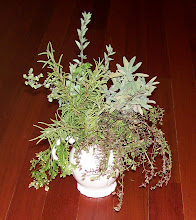
Showing posts with label herbs. Show all posts

Monday, November 14, 2011

Time to Winterize the Plants

I really hate this time of year.

It's the time of year when I have to bring
all the cold-sensitive plants inside for the season.

At this point, I've already brought in the houseplants.
But I've resisted bringing in the bay tree and the
rosemary plant as long as I can.

These herbs are among the more expensive herbs
and they are also rather cold-sensitive.

Bay laurel trees are native to the Mediterranean region
and cannot survive temperatures below 20 degrees.

In optimum conditions these trees could grow
to be 60 feet tall.

However, in Southern Indiana, they must be grown in pots
and brought inside in the winter.

The only major pest
which I have witnessed, is scale.
Treat with insecticidal oil, or simple remove by hand.


The bay tree has been very happy this year
and has grown to be almost five feet this season.

That is an increase of about 100% in one season.

I am happy to report that the scale infestation has
been eliminated as well.

Petunias have taken up residence in the pot.
Free loaders.


The great room has turned into a nursery.

The Foodie Boyfriend says that it looks like
"a jungle threw up in here."
Considering that I have to keep vacuuming
up the fallen leaves and the flower petals off the floor,
I'd have to agree with him.

Now I just have to keep the bay tree and the 
rosemary alive until spring.

Rosemary is always the problem 
as it doesn't like the dry climate of the house
no matter how often or how little I water it.
Rosemary is also a native to 
the Mediterranean basin.

While it thrives outside with relative ease,
rosemary struggles in an indoor environment.
And since rosemary cannot usually 
survive temperatures dipping below 30 degrees,
one must bring the plant indoors 
in order to keep it alive.

Let the plant dry out before watering
and keep an eye out for aphids, spider mites 
and powdery mildew.

In other words,
good luck.


Monday, May 11, 2009

Life on My Back Deck
I live for the time when I can escape to my back deck and leave all my worries behind me. And yes, that is a requirement. No worries allowed on my back deck. It's right there in the small print. What, you don't read these things before you sign them?


One of the benefits of growing veggies in pots on my south-facing deck is that I can plant them earlier. Already this tomato plant and the bell pepper are growing nicely.


This tomato is really happy. I am happy to report that the tomato plants already have flowers which mean tomatoes are in my culinary future. The basil plants also love this pot. In case you are wondering, marigold plants also grace each of these pots.


This pot holds another basil plant as well as an oregano plant and a flat leaf parsley plant. I sense good food coming from this pot.


Why yes, Virginia, you can grow lettuce in a pot. I have already harvested a few salads from this planting, via the cut-and-come-again-method. That means that I selectively cut individual leaves from the plants, allowing the individual plants to continue growing. Works for me, works for them...


Shhhh, don't say anything about this strange-looking rosemary plant. The poor thing had to endure my irregular watering habits all winter long. I do believe that it deserves a bigger pot for all of its suffering.


And finally we have my sage and bay tree in the far left pot, the four new Serrano chili plants in the middle pot and the common thyme and chive plants in the right-hand pot. The left-hand pot resided inside during the winter and just barely escaped with its life, while the thyme and chives have been going strong for several years now, even though the pot has been left out in the bitter winter weather each year. Guess that beats wondering if I'll remember to water it this week or not...


And now, won't you welcome our newest visitor to our deck? This gorgeous creature is a male Luna Moth. I know it is a male because of its 'enhanced' antenna. I'm not joking.

And this is why I spent so much time trying to figure out how to put this fountain together. There, I feel much better now.

Monday, January 12, 2009

Winter Herbs

Recently I had lamented that a dish would have been just that much better with the addition of some fresh Italian parsley. One of my readers, Rosie Hawthorne, who is blessed to live in a mild climate wondered why I just didn't grow my parsley in a protected South-facing location. Rosie, I hope that this post will answer your questions about my winter herbs.


This is what is left of my basil, Italian parsley and oregano. If I am lucky, the oregano will survive the winter.


This pot contains my thyme, chives and another oregano plant. I had to replace the oregano last spring as the original plant had died. The thyme and chives are several years old.

More Italian parsley grew in the middle pot.


As you can see, the pots sit next to the south side of the house near a protected corner. This is the best that I can do with the outside plants. I can plant my peppers and tomatoes earlier in pots on the deck than I could in the ground as this is a more protected area. They also last longer in the fall until it gets too cold.


Since bay plants cost so much, I brought this pot in (which also contains sage). Unfortunately, the plants don't get enough sun inside and I have difficulty getting them enough water.


The rosemary's new growth is spindly, indicating that it is not getting enough light. This is also another plant that requires a lot of water. Both pots are sitting in front of an east-facing door in a room that also has several south-facing windows.
All I can do is to hope to keep these alive until they can go back out on the deck in the spring.
Maybe I should consider getting a small portable greenhouse for my herbs.


I broke down and bought a bunch of Italian Flat Parsley for $1.49 at my regular grocery store. I placed them in water and put them in the fridge to keep the leaves fresh.
Look at the tag in the picture: now I know why Sandra Lee insists upon calling the stuff 'Flat Parsley', as if her fat aunt Bertha had sat on the plant, thus flattening it.


Monday, October 22, 2007

From the Garden to the Table

I thought I would share an article I wrote recently for my county's Master Gardener Association's monthly newsletter. Oh, did I mention that they were silly enough to elect me president of the organization for the past two years? I'm up for re-election in late Novemeber. Why do I keep saying yes? Anyway, on with the program:


Herbes de Provence from Your Garden

There are many reasons to garden: for the natural beauty, to attract wildlife, for our personal enjoyment, and perhaps most importantly, for food. Certainly one of the greatest joys for the gardener lies in putting the bounty of the harvest from the garden onto the dinner table. Likewise, growing one’s own herbs also adds to the enjoyment of gardening as well as eating.

People in the Provence region of southern France have been growing and blending their own herb mixtures for centuries. While the herbs used vary somewhat, certain herbs are almost always used. Bay leaves are often used, along with oregano, thyme, basil, rosemary, sage, marjoram, fennel seeds, and summer savory. Some recipes even call for the addition of lavender buds. My personal blend combines dried basil, oregano, rosemary, sage, thyme and lavender buds.

One of my pots of herbs - here we have thyme, chives and rosemary

Herbes de Provence can be used to season dishes of meat, poultry, eggs and vegetables. Italians have a similar blend, using many of the same herbs. Herbes de Provence is most often used for roasting and long stewing or braising, but can be sprinkled on anything that would benefit from a boost of Mediterranean flavor. However, the herbs are generally only used in the cooking process, as the flavors are a bit strong.

As these herbs are indigenous to both the southern France and northern Italian regions; they share many of the same conditions to flourish. These plants are adapted to hot, fairly dry conditions and rather poor soil, so they require a minimum of care in the garden. Indeed, basil is the one exception, as it requires a bit more water because the large surface area of its leaves allows for moisture loss. In contrast, the fine hairs on sage leaves protect the plant from excess transpiration.

These plants easily adapt to container gardening, with the added requirement that they be watered daily. A sunny spot and a large enough pot are all that is needed. These herbs evolved in an area where soil nutrients were poor, so extra fertilizers are not needed.

It should be noted that while basil and summer savory are annuals; fennel, oregano and thyme are perennial plants. Marjoram, rosemary and bay are all tender perennials and must be protected from cold weather. As bay, or laurel, is a rather expensive plant and can grow into an attractive small shrub or tree in a container; it is well worth the effort to bring this cold-sensitive plant inside in the winter.

Dried basil has a weak coumarin flavor, like hay. Bay laurel gives an aromatic and slightly bitter taste. Fennel seeds (or more correctly, fruit) have a strong licorice flavor. Lavender buds add a floral note and marjoram imparts sweet pine and citrus flavors. Oregano has an aromatic, warm and slightly bitter taste. Rosemary has a strong pine flavor, while sage adds an aromatic and slightly bitter flavor. Summer savory imparts a sweet, delicate aroma to foods and thyme is strongly aromatic.


Freshly picked herbs for my Herbes de Provence blend


At any time in the growing season, the leaves from these plants may be harvested for culinary use. For the best flavor, pinch the plants to encourage branching and to discourage flower production, as the flavor suffers once flowers appear. The exceptions are the fennel and lavender, where flower production is desired. Fennel seeds and lavender buds must necessarily be harvested at specific times of the year. Plants should be harvested in the morning after the dew has dried, but before the sun has a chance to activate the volatile oils in the plants.

Make sure the leaves are dry as to prevent spoilage, and clip a few sprigs of each plant desired. If using the herbs as a dry mix, rubber band a handful of herbs together and hang upside down in a cool, well ventilated, dry location for a few weeks. Once the herbs have dried sufficiently, remove the leaves from the stems and lay out on a paper towel to continue the drying process. It is important that the herbs not be stored in direct sunlight, as the light will cause the herbs to quickly lose their flavor.


Dried herbs stripped from the stems and ready to be chopped


Once the herbs have been thoroughly dried, finely chop the leaves and mix together. Store in an airtight container for up to six months.

Herbes de Provence


Herbes de Provence

Equal parts crushed leaves of:
Dried sage
Dried oregano
Dried thyme
Dried basil
Dried rosemary

Add:
One half-part dried lavender buds

One of our favorite uses for this blend is for homemade croutons. This is the recipe my daughter and I developed:

Homemade Croutons

This is an excellent way to use scrap bread that is leftover from other recipes. A firm bread works better than the usual white sandwich bread. Herbes de Provence adds a light, fresh flavor to the croutons. Otherwise, any dried herb blend or your favorite dried herbs can also be used with great results. CAUTION: This is not a dish that can be put in the oven and forgotten. The browning will occur within minutes and there is a fine, but disgusting, line between brown and burnt.

Bread, cut into a ¾ inch cube
Olive oil
Herb seasonings
Garlic powder, optional

Toss all ingredients together on a baking sheet or a toaster oven pan. Spread out evenly and bake at 350 degrees until golden brown. Watch carefully as this browns/burns quickly. A good tip is to toss the croutons once some begin browning and then turn off the oven before returning the croutons to the oven to finish drying/baking. Serve fresh croutons on your favorite salad and securely seal and freeze the remainder for another time.

I hope you can see that growing one’s own herbs is simple and rewarding. So give it a try and see how you can liven up your next meal.