Wednesday, October 24, 2007

Weird Weather

A particular interest of mine has always been weather. I have to admit it: if there is severe weather forecast, I will be near a window or outside – often with a camera. I have photographic evidence of two separate occurrences at our home here outside of Bloomington, IN. My husband and I had gone on a garden tour in late June when the weather turned ominous. We sent our children and our cat down to the relative safely of the basement, before my husband and I ventured outside to observe the situation. Earlier I had seen a funnel cloud heading our way before lifting back up into the clouds. With camera and video camera in hands, we set out to document the experience.

I forget, do we duck and cover or drop and roll?

It's looking worse...

It's a good thing I'm a brave soul

Can you believe this thing never actually touched down and caused any damage?

I admit it: it took me a few days to realize what I had taken a picture of here. Hint: it's the bottom of a vortex. Strange. It was quiet. Absolutely silent during all this. No freight trains, no rushing winds.


A second, rare event occurred a few years later. My understanding is that “snow rollers” can only be formed under very specific conditions. I would not be surprised to find that we never get to witness this phenomenon again.

How many people have ever seen a snow roller? Me!!!


Now, I simply must tell you about the extremely tense story that revolved around our decision to move from a place where three of the four of us were very happy (my husband hated his job, but my son, daughter and I were satisfied in our life in Cincinnati). My husband was without a job and had a prospect of a permanent job in Bloomington, I… What to do? We looked at the realities and decided that we needed to move, despite our personal feelings. For 11 months, my husband had been ‘living’ in this community during the week, only returning on the weekends. Our son refused to consider moving and refused to look at houses with us.

We looked at house after house and were not satisfied with any of them. New houses were scarce at this time and we were limited to the stock at hand. Then our house ‘sold’ and we were put on the spot. I took a step back and looked at the situation. We could change a house, given enough money, but you could not change or expand a lot.

That led us back to a house I had rejected during the first tour. The entry way was too narrow, the lights too modern, the house too divorce-ish. Don’t ask me how, but I can tell you just by walking in a house whether the family is happy or not. And this house was not happy. Of course, my uber-practical husband saw the divorce papers that had been left out on the counter. But in the end, we could change the house, and the lot was great. Much work needed to be done on the 3 year old house, as the builder had run out of money while building it.

After much deliberation, we put an offer on the house and drove back to Cincinnati on a fitful late spring afternoon. We were asking ourselves and each other if we really were doing the right thing and if we could be sure of that fact.

We had gotten almost halfway home when we started seeing rainbows. Now, there is nothing new there. Rainbows are simply a refraction of the microscopic water molecules in the atmosphere. There is a very real reason why being able to recover the pot of gold at the end of the rainbow is so important: it is impossible. The laws of physics tell us that we can never be anywhere but in the absolute middle of the rainbow, because a rainbow is an illusion based upon our position.

Now, keep that in mind as I tell you what three of us experienced that day. The rainbow ‘ran’ away from us as would be expected. Nothing unusual there. Suddenly, the rainbow ‘charged’ at us. And then the colors of the rainbow actually passed through the windshield and onto the dashboard of our car. I even remember the colors passing over my legs. We looked at each other, and three voices asked at the same time, “Did that just happen?”

We have become accustomed to people not believing us. Kelley has told of a high school teacher threatening to send her to the office for ‘lying’, and if not for the objections of her class mates that she would not lie, the teacher would have had her written up. Actually, it would be easier for us to believe that we three had had a shared delusion. After all, no one believes us. But we three know what we saw and we saw what we saw. I deeply regret that we have not pictures, but perhaps we were not meant to capture such an event. Perhaps some things in life are meant to remain a mystery.

Fun Food

Today’s offering is a recipe I have recently developed. Enjoy!


Panzanella

I was inspired by The Barefoot Contessa, Ina Garten for this recipe. I could not resist the temptation to twist and tweak things to my liking, however.

Salad:
Extra virgin olive oil
1 small French loaf, cut into ½ inch cubes
3 home gown, ripe roma tomatoes
3 baby seedless cucumbers
½ red pepper, diced into 1 inch pieces
½ yellow pepper, diced into 1 inch pieces
½ red onion, chopped into ½ inch pieces
10 fresh basil leaves, roughly chopped

Vinaigrette:
1 tsp. finely minced garlic
1/2 tsp. Dijon mustard
3 tbs. Champagne or white wine vinegar
1/2 cup extra virgin olive oil 1/2 tsp. kosher salt
1/4 tsp. freshly ground black pepper

Layer the bread cubes on a baking sheet. Drizzle extra virgin olive oil over the top and bake at 350 degrees until golden brown. Watch carefully as bread browns and then burns quickly.

Mix all the ingredients for the vinaigrette together.

In a large bowl, mix the tomatoes, cucumber, red pepper, yellow pepper, red onion, and basil. Add the bread cubes and toss with the vinaigrette. Season with salt and pepper. Allow to sit for up to 2 hours to allow flavors to meld.

Tuesday, October 23, 2007

Meet the Family? – Folia and Flora


Dracaena and areca palm


Oh my, the writer has truly lost her mind now. Perhaps that’s what only 3 hours of sleep will do to you – or is it because my house plants truly are part of the family? I bought a golden pothos when I went to college 26 years ago and that plant is still with us. My husband found out very early on that you don’t mess with my plants. Soon after we had married, I caught him dumping his toenail clippings in that very plant. I am happy to say that the man quickly learned the error of his ways and my plants have been safe from detritus ever since.


"Old Reliable" - my first orchid. It blooms almost non-stop


When my children were young, they would frequently hear the admonishment from Mom that “I’ve had this plant longer than I’ve had you, so…” Even my cat knows better than to mess with Mom’s plants. It’s good to be the queen.


Ficus and Christmas Cactus


My second oldest surviving plant (an important designation, as I have probably killed more plants than most people have ever grown) is actually the ‘daughter’ of a spider plant I was given when I was a teenager. The ‘daughter’ is 25 years old and the ‘granddaughter’ is 15 years old. Each plant has a special place of honor inside the home.


Spider plant hanging on the second floor landing


And then there is the schefflera plant. I bought the plant in a 4 inch pot when my youngest child was just a few months old. That plant is now 9 feet tall (or it would be if it would quit slouching) and currently resides in a pot that is nearly 2 feet across. I have no intentions of ever repotting that behemoth again.


Schefflera (Umbrella plant) - stand up straight, please!


Recently, I had to see an allergist and at one point I was asked if I had any houseplants. Upon hearing an affirmative answer, the nurse asked how many: “One, two…?” “No", I replied. "About 50.” The nurse blinked once, twice. And then they had the audacity to tell me that given my allergies to various molds, I should put my plants outside. Besides the fact that that just isn’t going to happen, it would be a crime against plant life as it gets cold in the wintertime. Freezing even. Get rid of my plants. Really. I think not.


Orchid - I call this beauty "Blushing Ladies"


For some odd reason, I have become known as an orchid person. Maybe it has something to do with the 15 orchids I currently have? Hmm, I will have to ponder that mystery. I bought my first orchid 11 years ago, and while I liked it, all seemed to be well. But then, I toured an orchid greenhouse and bought a second orchid. That was the moment my sickness revealed itself – I had become obsessed with orchids. Now it takes superhuman strength to keep from purchasing yet another orchid. You know, I have no idea why my husband and daughter roll their eyes when I innocently proclaim that it wasn’t my fault and that the orchid followed me home from the store.


Orchid - notice the veining in the flowers


Every once in a while, especially when I can’t sleep (Hey, you can count your sheep, I’ll count my plants!), I try to figure out just what I do have. A quick walk around the house this morning yielded this accounting (The count is for the number of pots, not necessarily the number of plants):


Golden Pothos (Devil’s Ivy) - 5
Spider Plant – 2
Parlor Palm – 3
Ficus – 2
Christmas Cactus – 4
African Violets – 2
Ivy – 2
Ochids – 15
Dracaena – 1
Pony Tail Palm - 1
Schefflera (Umbrella plant)– 1
Spathaphyllum (Peace Lily)– 1
Aloe – 1
ZZ Plant (Hey, you try saying ‘Zamioculcas zamifolia’!) – 1
Papyrus (brought in from the water garden for the winter) -1
I will also be bringing in two of my herb garden pots from the deck, as well as a very nice looking Geranium (Pelargonium).


Another orchid


See, not too many plants at all! But I did compromise with the allergist and removed the plants from my bedroom. Aren’t you proud of me? It still hurt, but I’ll survive. Another suggestion I intend to follow is to cover the potting medium of all my houseplants with small pebbles. Of course, they would be difficult to find at this time of the year.


Colmanara and Dendrobium orchids blooming together (these are the only two orchids pictured here that are not currently blooming)


The 'ZZ' plant - it's a relative of Cycads (they are thought to be relatives of the oldest surviving plant species)


I mentioned in an earlier post that I am a Master Gardener. I am actually a Certified, Advanced, Bronze-level Master Gardener, thank you very much. If you love gardening and/or plants and like helping and teaching others, then you might consider becoming a Master Gardener. You can contact your local Extension Office and ask about Master Gardener classes and what your particular state requires for interns to become certified. A common misconception about the Master Gardener program is that its members are a source of free labor. Not so; our purpose is to teach, not to do manual labor for others. A commitment to volunteer a certain amount of hours each year is required once classes and testing have been completed, and after certification, additional education hours must also be earned yearly. It sounds more difficult than it truly is, but I can promise you that the personal rewards are worth it.

Monday, October 22, 2007

From the Garden to the Table

I thought I would share an article I wrote recently for my county's Master Gardener Association's monthly newsletter. Oh, did I mention that they were silly enough to elect me president of the organization for the past two years? I'm up for re-election in late Novemeber. Why do I keep saying yes? Anyway, on with the program:


Herbes de Provence from Your Garden

There are many reasons to garden: for the natural beauty, to attract wildlife, for our personal enjoyment, and perhaps most importantly, for food. Certainly one of the greatest joys for the gardener lies in putting the bounty of the harvest from the garden onto the dinner table. Likewise, growing one’s own herbs also adds to the enjoyment of gardening as well as eating.

People in the Provence region of southern France have been growing and blending their own herb mixtures for centuries. While the herbs used vary somewhat, certain herbs are almost always used. Bay leaves are often used, along with oregano, thyme, basil, rosemary, sage, marjoram, fennel seeds, and summer savory. Some recipes even call for the addition of lavender buds. My personal blend combines dried basil, oregano, rosemary, sage, thyme and lavender buds.

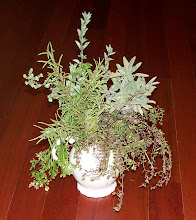
One of my pots of herbs - here we have thyme, chives and rosemary

Herbes de Provence can be used to season dishes of meat, poultry, eggs and vegetables. Italians have a similar blend, using many of the same herbs. Herbes de Provence is most often used for roasting and long stewing or braising, but can be sprinkled on anything that would benefit from a boost of Mediterranean flavor. However, the herbs are generally only used in the cooking process, as the flavors are a bit strong.

As these herbs are indigenous to both the southern France and northern Italian regions; they share many of the same conditions to flourish. These plants are adapted to hot, fairly dry conditions and rather poor soil, so they require a minimum of care in the garden. Indeed, basil is the one exception, as it requires a bit more water because the large surface area of its leaves allows for moisture loss. In contrast, the fine hairs on sage leaves protect the plant from excess transpiration.

These plants easily adapt to container gardening, with the added requirement that they be watered daily. A sunny spot and a large enough pot are all that is needed. These herbs evolved in an area where soil nutrients were poor, so extra fertilizers are not needed.

It should be noted that while basil and summer savory are annuals; fennel, oregano and thyme are perennial plants. Marjoram, rosemary and bay are all tender perennials and must be protected from cold weather. As bay, or laurel, is a rather expensive plant and can grow into an attractive small shrub or tree in a container; it is well worth the effort to bring this cold-sensitive plant inside in the winter.

Dried basil has a weak coumarin flavor, like hay. Bay laurel gives an aromatic and slightly bitter taste. Fennel seeds (or more correctly, fruit) have a strong licorice flavor. Lavender buds add a floral note and marjoram imparts sweet pine and citrus flavors. Oregano has an aromatic, warm and slightly bitter taste. Rosemary has a strong pine flavor, while sage adds an aromatic and slightly bitter flavor. Summer savory imparts a sweet, delicate aroma to foods and thyme is strongly aromatic.


Freshly picked herbs for my Herbes de Provence blend


At any time in the growing season, the leaves from these plants may be harvested for culinary use. For the best flavor, pinch the plants to encourage branching and to discourage flower production, as the flavor suffers once flowers appear. The exceptions are the fennel and lavender, where flower production is desired. Fennel seeds and lavender buds must necessarily be harvested at specific times of the year. Plants should be harvested in the morning after the dew has dried, but before the sun has a chance to activate the volatile oils in the plants.

Make sure the leaves are dry as to prevent spoilage, and clip a few sprigs of each plant desired. If using the herbs as a dry mix, rubber band a handful of herbs together and hang upside down in a cool, well ventilated, dry location for a few weeks. Once the herbs have dried sufficiently, remove the leaves from the stems and lay out on a paper towel to continue the drying process. It is important that the herbs not be stored in direct sunlight, as the light will cause the herbs to quickly lose their flavor.


Dried herbs stripped from the stems and ready to be chopped


Once the herbs have been thoroughly dried, finely chop the leaves and mix together. Store in an airtight container for up to six months.

Herbes de Provence


Herbes de Provence

Equal parts crushed leaves of:
Dried sage
Dried oregano
Dried thyme
Dried basil
Dried rosemary

Add:
One half-part dried lavender buds

One of our favorite uses for this blend is for homemade croutons. This is the recipe my daughter and I developed:

Homemade Croutons

This is an excellent way to use scrap bread that is leftover from other recipes. A firm bread works better than the usual white sandwich bread. Herbes de Provence adds a light, fresh flavor to the croutons. Otherwise, any dried herb blend or your favorite dried herbs can also be used with great results. CAUTION: This is not a dish that can be put in the oven and forgotten. The browning will occur within minutes and there is a fine, but disgusting, line between brown and burnt.

Bread, cut into a ¾ inch cube
Olive oil
Herb seasonings
Garlic powder, optional

Toss all ingredients together on a baking sheet or a toaster oven pan. Spread out evenly and bake at 350 degrees until golden brown. Watch carefully as this browns/burns quickly. A good tip is to toss the croutons once some begin browning and then turn off the oven before returning the croutons to the oven to finish drying/baking. Serve fresh croutons on your favorite salad and securely seal and freeze the remainder for another time.

I hope you can see that growing one’s own herbs is simple and rewarding. So give it a try and see how you can liven up your next meal.

Sunday, October 21, 2007

Into the Wilds

We are fortunate enough to live near a town that is home to a Big Ten university and so have access to all the benefits that come with that. We happen to live in a subdivision out in the country, just a couple of miles from a national forest and a large man-made lake.

As you might imagine, such a habitat lends itself to a closer relationship with nature. Today I thought I would share some stories of our dear neighbors. Oh dear, that is a pun, isn’t it? Well, of course we have deer. Many deer. Deer who are not at all shy about coming right up to the house and looking in the windows.

Over the course of the years, we have even had a herd of cattle in our yard. After I called the sheriff, I got to watch him moo-ve them back to where they belonged. Wild Turkeys, Blue Herons, Canadian Geese and a Bald Eagle have also been observed. Last winter a Northern Harrier stopped by our deck for a bit, and Turkey Vultures live in the abandoned barn behind our property. We also have the usual assortment of smaller birds who frequent my bird feeders: Cardinals, Chickadees, Tufted Titmice, Nuthatches, Gold Finches, House Finches, Field Sparrows, Mockingbirds, Red Bellied Woodpeckers, Hairy Woodpeckers, as well as our summer visitors, Hummingbirds.


Tadpoles are so much fun to watch

For some odd reason, American Tree Frogs love to live on our upper level deck and invariably one will fall out when the patio umbrella is opened. Cushions must be checked to ensure that no frogs are squished upon sitting. For the past several years I have had a water garden in a pot on the deck and the frogs make use of that to raise their young. Tadpoles are another fun addition to the ‘family’. This past summer I even found a beautiful snake on my deck. I took its picture, though the snake proved to be rather camera shy and immediately left. An email to my county’s Extension Agent helped to identify this new visitor: an Eastern Milk Snake. They are non-venomous and are considered to be an endangered species. It was simply beautiful.


The frogs are having a secret meeting


Eastern Milk Snake - Hey! That lump in your belly better not be one of my frogs!


Though we have never seen any, the evidence of their presence can be sniffed out. That’s right. Skunks. I leave them alone, and I hope they leave me alone. Raccoons are also regular nocturnal visitors in the winter. Unfortunately, they have found the bird feeders and will empty them in a single feeding. I also learned that a ‘squirrel-proof’ bird feeder is not a ‘raccoon-proof’ feeder. The only solutions are to either take the feeders in at night, or to only fill the feeder to a minimum level each day to avoid excess loss. Squirrels also visit in the winter to feed from the feeders. We have named one “Stumpy” because of his missing tail. While squirrels generally use their tails as hanging devices and a counterweight, Stumpy seems to have adapted to his loss.


Stumpy has stopped by for lunch


The eerie howl of Coyotes can sometimes be heard late at night, but they are rarely seen. The one I did see a few years ago was a mangy looking thing, so I will count it as a blessing that we rarely see them. We have many other neighbors, but I hope you enjoyed this brief introduction to our neighborhood.


Friday, October 19, 2007


Let’s Talk Food!

I don’t know about you, but I am ready to talk about the food again. Foodies Untie! Oops, Unite! This morning I decided to make a dish I had not made since Home-Ec. in high school (more years ago than I care to admit!). Disclaimer: I had already had a couple of cups of coffee before I started on the dangerous task of cooking. No cooks or kitchens were harmed in the making of this dish.


Start with two eggs


I actually took the time this morning to make myself a French Omelet. First I separated two eggs. Then I got out my trusty whisk and went to work on the egg whites. After the whites had increased to about 3 times the original volume, I lightly beat the yolks. Then I added the yolks to the whites and mixed lightly.


Separate them


No, not like that!


Like this!


Mix the beaten yolks with the frothy whites


Meanwhile, I browned one tablespoon of unsalted butter in a small pan and added about a tablespoon of chopped onion to the butter. I gently poured the eggs into the pan and added kosher salt, freshly cracked black pepper, and a sprinkling of dried Herbes de Provence. Gruyere cheese sounded like a wonderful addition, but alas, none was to be found in my refrigerator. So, on to the old standby: cheddar. Shredded cheddar cheese went on the top and the omelet was folded over to finish cooking. More cheese on top and a couple of slices of pre-cooked bacon went into the pan. I put a lid on the pan and turned off the heat to allow the omelet to finish cooking.


The French Omelet - not bad for someone who hasn't made one in 30 years!


In the end, I realized I put too much salt for my taste on the omelet, but it was otherwise perfect. And it was definitely worth the little bit of extra effort. I will be making French Omelets again.


We eat lunch...


I never realized just how often I eat chicken. Now that I know that I am allergic to chicken, I need to rethink my lunches. This was my first attempt at making something other than leftovers or chicken for my lunch:

I like vegetables - and I can use a knife!


I sliced a green onion on the bias and julienned a carrot. A quick slice of a rib of celery and a large dice of a quarter of a yellow bell pepper and I was ready for the teriyaki sauce and the meat. I mixed together ¼ cup low sodium soy sauce, 2 tablespoons white wine and 1 tablespoon sugar. I then whisked in about 6 tablespoons canola oil. This will make more sauce than you will need for one serving.

As my daughter would say, I cheated on the meat. I bought two packages (hey, it was Buy One, Get One Free) of chopped, shaped, thinly sliced beef sandwich steaks. One “steak” cut into ½ inch wide strips completed the ingredient list.

Uh-oh, I Semi-HO'd my lunch


I heated a sauté pan over medium-high heat and added a drizzle of canola oil. First I sautéed the onion, bell pepper and carrots. Then I added the celery and cooked for a moment longer. I removed all to a plate and sautéed the beef that had been placed in the teriyaki sauce. Once the meat was cooked, I added the vegetables back in and poured in the sauce before turning off the heat and plating.

Look what I can do!


If I had more time, I would have made rice to go with this. All in all, I would count this as a success. The meat was tender and the vegetables were crispy and flavorful, just as I like them. I almost didn’t miss my favorite chicken.

My lunch just before I dug in.

All picture of lunch courtesy of Kelley.

Thursday, October 18, 2007

Meet More of the Family - Kevin

He's down there somewhere - really!

Our oldest child has long since moved out of the nest and gone off into the cold, hard world. He went to our local Big Ten university and married his high school sweetheart. Soon after Kevin graduated from college, he accepted a job with a bank software development firm. His first position there was in quality control, but soon he was able to move up into his favored field - computer programming.


He and his wife, Chantel, are now expecting their first child, regardless of the fact that that will make me older. I might even have to grow up someday!


Kevin and his future wife, Chantel, at their high school graduation


Kevin and his sister Kelley - I think Chantel was hiding from the camera that day!