Road Trip: The Foodie Girls' Final Destination
The Foodie Girls have been planning this trip for months and we had one destination in mind:
to visit with my good fellow foodie and blogger,
Rosie Hawthorne of Kitchens Are Monkey Business fame.
Rosie Hawthorne of Kitchens Are Monkey Business fame.
Oh, and did I mention that Rosie is also a fellow gardener extraordinaire?

The larkspur and foxglove are beautiful.

The glass "fish pond."

Spotted leopard plant?

Sunset from the deck.

The Hawthornes intended to treat us with their unique Outer Banks eats while we visited with them.
First up on the menu was soft shell crabs.
These crabs are still alive - but not for long.

Mr. Hawthorne demonstrates how he prepares the crabs.
First he cuts off the face.
I thought I would be squeamish about this, but they are just aquatic bugs, so what the hey.

Then after cutting off the apron, he cuts off the gills, or dead men's fingers.

More cleaning. Mr. Hawthorne explained that he cleans out the inner organs such as tomalley that many restaurants don't bother to remove.
Mr. Hawthorne is very particular about his food.
Mr. Hawthorne is very particular about his food.

Our wonderful hostess, Rosie Hawthorne, records Mr. Hawthorne as he cleans a soft shell blue crab.

The plated dish.
As a landlocked landlubber, I have to admit that this dish can look intimidating to the uninitiated.
It is good, however.
Thank you, Hawthornes, for introducing us to this Outer Banks delicacy!

I awoke early the next morning and wandered about a bit before my hosts woke up.
I found this picture of this scene and had to take a picture of it.
And wouldn't you just love to have this view out your window?

But it turns out that one must earn one's keep at the Hawthornes' abode.*
Here, the Foodie Daughter is working on Rosie's latest garden project, a succulent chair.
*Just kidding, Rosie. We had fun doing it.

Between the three of us we figured out how to successfully wrap the chicken wire and the coco fiber mat around the back of the old wicker chair.
Then came the "fun" part: trying to convince potting soil to defy gravity and stay in place.

And we began placing plants in the pockets between the slats. We learned to break some plants apart and to cut some slats in order to fit them in.

See what I mean about gravity?


We got better as we progressed.

The finished project.
The chair was definitely back-heavy, so we made sure to place it where it would be able to lean against something and we placed a couple of pots on the seat.
Hopefully the plants will take hold and flourish as time goes on.

And now some more pictures from Rosie's beautiful, lush garden.


I have to admit that I have a bit of green-thumb envy. It's hard not to when Rosie can grow things I cannot given that she lives in zone 8a and I live in zone 6a and that those plants absolutely flourish in those conditions.

And of course Rosie is an excellent cook.
We were served sautéed scallops with slightly
cooked greens.
Simply delightful.
 ,
Of course we had to have Eggs Hawthorne, Rosie's version of Eggs Benedict.

Rosie also made us tuna melts for lunch. Simple and satisfying.

Then it was my turn to make dinner.
Wild Mushroom Fettuccini.

On Friday morning Rosie took the Foodie Girls to Roanoke Island to see the Elizabethan Gardens.

The day started off beautiful and warm.

The replica of the Elizabeth II, one of seven ships that made the voyage to Roanoke Island in 1585.
This replica resides at Roanoke Island Festival Park.

We arrived at the Elizabethan Gardens.

The gardens were created as a tribute to the first English colonists in the New World.
The gardens were built on the site of the original colony.


An interesting history of the gardens from the website can be found here.


The statue of Queen Elizabeth I.


Carrara marble statue of Virginia Dare, the first white child born in the New World.


This path leads down to the sound.

We note that the weather has turned.


The Foodie Daughter and Rosie walk on ahead.


We entered the Woodland Garden.

We found it to be populated by gnomes.


Spanish moss grows on a tree.

A magnolia in bloom.

The magnolia tree.


The hydrangeas were just beginning to bloom.

Oakleaf hydrangea.

The rose garden.

Iris in bloom.

A tree draped in a flowering vine.


As we headed back across the sound to the Outer Banks, we encountered rain.

Before returning to Rosie's home, we stopped at the beach.
The temperature had dropped ten degrees from the time we had started out.

The Wright Brothers Monument is off in the distance.

A beautiful sunset from Rosie's deck.

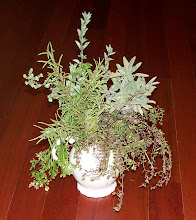
Flowers from Rosie's garden.

How is this for a delicious meal:
deep-fried scallops and broccoli salad?
I'm loving it.

Between meals I stepped outside and noticed this warning posted at the front door.
Don't mess with the Hawthornes!

Middle Hawthorne caught a few speckled trout Friday morning.
Mr. Hawthorn then cleaned the fish and baked them before frying them for dinner.


I have to admit that I normally don't care for fish as I find it to be too "fishy."
But this was amazing.

Rosie has a chandelier hanging in her tree!

Rosie and the Foodie Girl come out of the Witless Protection Program long enough to model their new matching T-shirts.
I was asked to protect the identities of the innocent and not-so-innocent.
The Foodie Daughter chose to remain in hiding.
The Foodie Girls reluctantly said goodbye to our gracious hosts and returned home to Southern Indiana.
We had a wonderful time with the Hawthornes.
They treated us like royalty and yet like family at the same time.
We hope that the Hawthornes will choose to visit with us sometime soon.
We'd love to return the hospitality and show them around B-town.