Dining in Chicago
At last we get to the food.
And there was a lot of food
to be had in Chi-town.
And it was expensive,
at least in downtown.
For our first meal in the Windy City
(named for the politicians, not the weather),
we decided to go to Shula's at the Sheraton Towers
where we were staying.

Make no mistake;
this would be our most expensive meal of the trip.

We both opted for ice water and I asked
for lemon on the side.
I got four lemon wedges.
This almost passes Rosie Hawthorne's test
as she judges a restaurant on whether
they will actually give her the five lemon slices
that she requests to go with her iced tea.

After ordering,
our waiter brought out a basket of bread.

Both of us ordered the special of the night;
two 5 ounce petite filets with peppercorn sauce.
I ordered mine rare while my husband
ordered his medium rare.
These were, as usual,
cooked one scale up,
meaning that mine was medium rare
and my husband's was medium.
Remember that when you order a meat dish
at a restaurant.
However, they were delicious and tender.
Prime meat, indeed.
I will have to replicate this sauce at home.

I chose a side of lobster mashed potatoes
to go with my petite filets.
The flavor of lobster permeated every bite
and there were bits of lobster throughout.
Sublime.

My husband ordered the twice baked potato.
You cannot tell from this picture,
but this thing was huge.
It was at least eight inches long.
That was a potato on steroids.
This was a delicious meal,
but with tip, it set us back $137.67.

The next morning we headed out to the Navy Pier.
We found out that we were too late to eat breakfast,
and thus began our "tradition" of only eating two meals
a day while in Chicago.
Thus also began our tradition of eating outside
whenever possible as the weather was
absolutely gorgeous while we were there.
We decided to eat lunch at Harry Caray's Tavern.


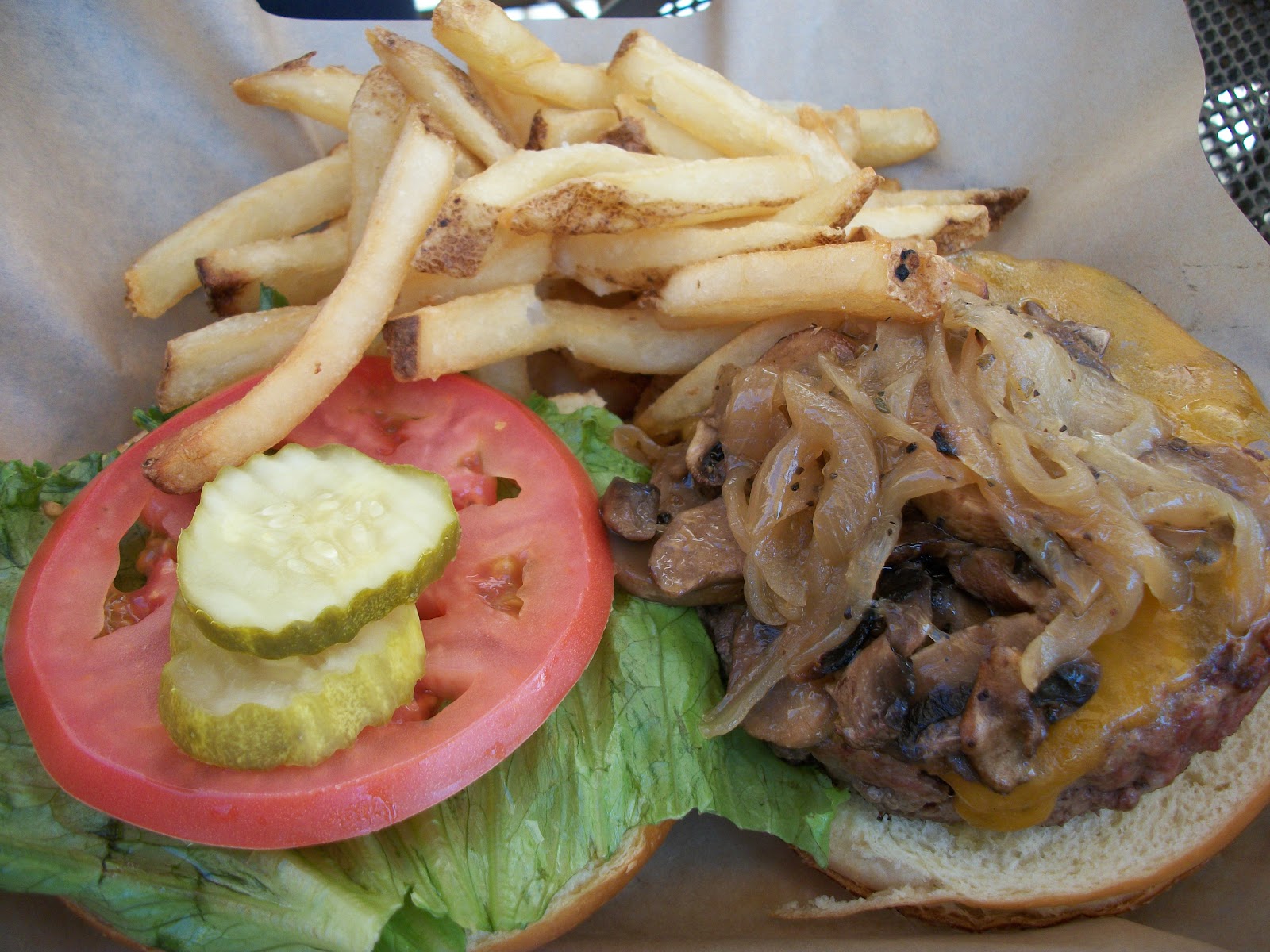
My husband ordered the Holy Cow! Burger
which is their signature 10 ounce sirloin burger
topped with cheddar cheese,
sauteed onions and sauteed mushrooms
on an egg bun. This came with fries.
All for $13.95.

I ordered the Hawaiian burger.
This was a 10 ounce sirloin burger topped with
thinly sliced Canadian bacon and grilled sliced
pineapple with a side of teriyaki aioli on a brioche bun.
With fries this cost $14.95.
Two beers each, at $5 a glass set us back even more.
The food, it ain't cheap here.
And it is big.
It's a good thing we are doing a lot of walking.

Still feeling the effects of lunch,
we decided on a lighter dinner.
Next to the hotel is an place called
Lizzie McNeill's Irish Pub.
It is right on the river walk and we decided
to sit outside and enjoy the views.


The menu


My husband ordered the corned beef sandwich
with chips.

I ordered the Burgundy.
They were out of ciabatta rolls
so they put this on Texas toast.
I also opted for chips as a side.
I ordered a Guinness since I was at an Irish pub.

I was on my own on Monday morning
and I decided to try the LB Bistro & Patisserie
in the hotel.
It is the first restaurant by renowned pastry chef
Laurent Branlard.

The blown glass sculpture outside the restaurant.


The floor of the restaurant is made of glass mosaics.

After perusing the menu and the prices,
I opted for the full breakfast buffet.
I chose an apple turnover,
an omelet (I got to chose the filling ingredients
and a chef made the omelet for me),
bacon, sausage links
and sauteed potatoes.
The apple turnover was very good
as was the omelet.
But the potatoes were swimming in oil,
which contaminated the bacon, making them greasy.
The absolute worst thing on the plate
was the sausage.
They looked plump and when I cut into them,
they looked juicy.
However, that "juice" was grease
and I couldn't eat much more than a bite or two
of them.
Which is a shame.
Chef?
You NEED my sausage recipe.
You really do.
Have your people call my people and
we'll work out a deal.
So I'd have to say that this has
to be my most disappointing meal of the trip.
From that,
let's go on to one of our most pleasant meals.
For our Class Reunion,
one of our class members set up
a dinner at Francesca's.
This restaurant was next to
the John Hancock Center.
It turned out to be a good thing that I had
checked out where the restaurant was
earlier in the day when I was out because
our taxi driver
(check off another bucket list item - ride in a taxi!)
missed the turn and we had to walk a block
back to the place.

The menu changes regularly
and this was the menu of the day.
While we waited for our orders to be taken
plates of fresh bread and freshly grated parmesan cheese
and small pitchers of herb infused olive oil were
set out for us to enjoy.
These were refreshed several times
before our dinners arrived.
The couple who had chosen the restaurant
ordered an appetizer of calamari fritti,
or fried calamari.
They couldn't eat it all and encouraged us to try some.
I had never had calamari, or squid, before,
so I timidly tried some.
First I tried a ring, or a bit of the body of the squid.
It wasn't bad.
Then they convinced me to try the tentacles.
I have to admit that the tentacles are my favorite part.
They are meatier and more flavorful.
I like calamari now.
And I am so proud of the Foodie Husband.
He also tried the calamari.

Our food arrives!
My husband ordered Spada Escada,
which is pan roasted swordfish with marinated
red, orange and yellow tomatoes, basil, croutons
and honey balsamico.
$24.99

I ordered the Vitello alla Disperata,
which is roasted veal medallions with peppers,
red onions, wild mushrooms, garlic,
white wine and olive oil.
$29.99.
Our hosts were kind enough to remember my
infamous chicken allergy in not only choosing
this restaurant,
but also in reminding me
to not order anything on the menu with "pollo".
Our hosts outdid themselves in picking this restaurant.
The food was wonderful and of course,
the company was delightful.

On Tuesday morning my husband and I headed
down the block and across the river to the
Corner Bakery Cafe.


After ordering,
we found seats outside along Upper Wacker Dr.


Oops, I almost forgot to take pictures.
The Foodie Husband ordered
the All American Scrambler
with Applewood smoked bacon,
toast and home fries.

I ordered the Farmer's Scrambler with peppers,
mushrooms and onions, toast and home fries.

After going back to the Navy Pier,
I stopped by a corner market and picked up some
food to nosh on before heading back to the room.

This looks like a lovely setting for lunch.


I purchased a honey sausage stick,
a smoked sausage stick a croissant and a
bottle of water.
I decided that I liked the honey sausage very much
and saved the smoked sausage for my husband.
I also decided that we would be stopping at that
market before heading home.
And for the piece de resistance:
hotel banquet food!
In fact, it was so memorable - not -
that had I not photographed it,
I would not have remembered it the next day.
That's not to say that it was bad;
just that it wasn't great.

After all the pomp and circumstance that comes
along with these events,
our salads arrive.
Pretty and probably the best part of the meal.

Then came the entree.
Beef, carrots and beans
and a potato concoction that was rather uninspiring.
Again, not bad as these things go,
but about what you'd expect from these sort of things.
There was dessert in there somewhere
but I didn't care by then.

I said we'd stop by that market and we did.
Just don't ask how we got from here to there.
I got more honey sausage,
some smoked sausage,
a half pound of mortadella
and a loaf of brioche bread.
We had a wonderful time in Chicago
and learned that Chicagoans love their food.
It doesn't hurt if you can walk it off, though!